
The Bus Factor Bomb: How Key-Person Dependency Risk Is Quietly Threatening Your Enterprise Codebase

The Bus Factor Bomb: How Key-Person Dependency Risk Is Quietly Threatening Your Enterprise Codebase

Every enterprise engineering org has at least one critical service that only one person truly understands — and no dashboard tracks it until that person quits, burns out, or goes on leave during an incident. Discover how Keypup MCP quantifies bus factor across your codebase, ranks services by knowledge concentration risk, and gives leadership a data-driven case for pairing and documentation before the exposure becomes an outage.

Stephane Ibos
Keypup MCP Server + ChatGPT and Claude: Conversational Engineering Analytics, No Dashboards Required

Keypup MCP Server + ChatGPT and Claude: Conversational Engineering Analytics, No Dashboards Required

Keypup's MCP server now connects directly to ChatGPT and Claude, letting engineering leaders ask plain-language questions about DORA metrics, cycle time, throughput, and team performance and get instant, formatted answers — charts, tables, and KPIs included. This guide walks through how both integrations work, the concrete benefits over traditional dashboards, and five real prompt-and-output examples spanning delivery velocity, quality, cycle time, and team performance.

Stephane Ibos
Pre-Production Environment Contention and Staging Drift: Why "Time to Release" Is Lying to You

Pre-Production Environment Contention and Staging Drift: Why "Time to Release" Is Lying to You

Enterprise releases don't move straight from commit to production — they queue through Integration, QA, UAT, Staging, and Pre-Prod, shared environments too expensive to replicate per team. Contention creates massive queues while staging drift causes builds to fail for reasons that have nothing to do with code quality. Standard SDLC analytics blame engineering for the resulting spike in Time to Release. Discover how Keypup MCP separates real code defects from environment queue wait and configuration drift, so leadership stops penalizing teams for infrastructure problems.

Arnaud Lachaume
The Multi-Service "Release Train" Problem: Ending Distributed Blame Attribution

The Multi-Service "Release Train" Problem: Ending Distributed Blame Attribution

Enterprises with tightly coupled systems can't release one microservice at a time — dozens of teams get bundled onto synchronized "release trains" across shared databases and legacy message buses. When a train fails, standard SDLC dashboards flag every participating team with a Change Failure, even the ones whose code was completely stable. When one team's late pull request delays the whole train, nobody's metrics capture it. Discover how Keypup MCP performs root-cause attribution across repository boundaries, ending the finger-pointing that per-team dashboards can't resolve.

Thomas Williams
ITIL and CAB Governance Bottlenecks Are Distorting Your Lead Time for Changes Telemetry

ITIL and CAB Governance Bottlenecks Are Distorting Your Lead Time for Changes Telemetry

In regulated enterprises — finance, healthcare, telecom — code can be written, tested, and merged in three hours, then sit for two to three weeks waiting on a Change Advisory Board slot. DORA's Lead Time for Changes can't tell the difference between active engineering work and passive bureaucratic wait, so executive dashboards flag a "velocity problem" that doesn't exist. Discover how Keypup MCP decomposes Lead Time into engineering-controlled time versus CAB queue wait, exposes SLA-breaching change categories, and gives engineering leadership the receipts to stop absorbing blame for a compliance calendar.

Arnaud Lachaume
Data Ownership, Governance, and Inter-Departmental Silos: Who Owns the Definition of a Story Point?

Data Ownership, Governance, and Inter-Departmental Silos: Who Owns the Definition of a Story Point?

Centralizing SDLC data across ten business units exposes a governance vacuum long before it delivers insight: seven competing "story point" scales, four business units with no named data owner, and a workflow taxonomy nobody was ever assigned to define. This isn't a GDPR problem — it's a political and technical negotiation over who owns what data, and who is accountable when a poorly maintained JIRA board quietly skews a portfolio-wide metric. Discover how Keypup MCP makes data ownership, definition consistency, and governance maturity measurable across every business unit.

Stephane Ibos
Change Management and Cross-Functional Alignment: Getting HR, Product, and Marketing to Trust Engineering Metrics

Change Management and Cross-Functional Alignment: Getting HR, Product, and Marketing to Trust Engineering Metrics

Rolling out SDLC analytics across an enterprise takes more than an engineering VP's buy-in. If HR misreads flow metrics in performance reviews, or Product Management keeps demanding features while ignoring system health, the initiative quietly becomes an "engineering-only project" that never earns organization-wide trust. Discover how Keypup MCP builds the guardrails, translations, and cross-functional accountability that make SDLC analytics stick beyond engineering.

Liam Davis
Strategic Vendor Selection and Platform Fatigue: How to Add an SEI Platform Without Adding Another Dashboard

Strategic Vendor Selection and Platform Fatigue: How to Add an SEI Platform Without Adding Another Dashboard

Enterprises already juggle dozens of tools for project management, CI/CD, monitoring, and HR. Before adding a Software Engineering Intelligence platform, IT architects and procurement teams need to weigh true integration cost, training burden, and vendor lock-in risk — not just the license fee. Discover how Keypup MCP delivers engineering insight through the tools your teams already use, with no new dashboard, no new login, and a fraction of the total cost of ownership.

Thomas Williams
The Standardization Fallacy: Why Uniform DORA Metrics Fail Heterogeneous Engineering Portfolios

The Standardization Fallacy: Why Uniform DORA Metrics Fail Heterogeneous Engineering Portfolios

A single VP overseeing cloud-native SaaS, legacy mainframe, firmware, and regulated banking teams cannot grade them all on the same DORA scale. Discover why forcing uniform "Elite" deployment frequency and lead-time targets onto heterogeneous portfolios penalizes safety-critical teams and introduces real operational risk — and how Keypup MCP builds risk-adjusted, tier-based benchmarks for every team automatically.

Arnaud Lachaume
Bridging the CFO Translation Gap: How Engineering Analytics Can Finally Speak Finance

Bridging the CFO Translation Gap: How Engineering Analytics Can Finally Speak Finance

Enterprise CFOs need financial outcomes—revenue growth, cost reduction, EBITDA impact, and R&D capitalization. Yet engineering teams track deployment frequency and PR cycle time. Discover how the Keypup MCP bridges this critical translation gap, automatically mapping technical delivery metrics to financial impact and enabling accurate CapEx/OpEx categorization for R&D tax credits.

Stephane Ibos
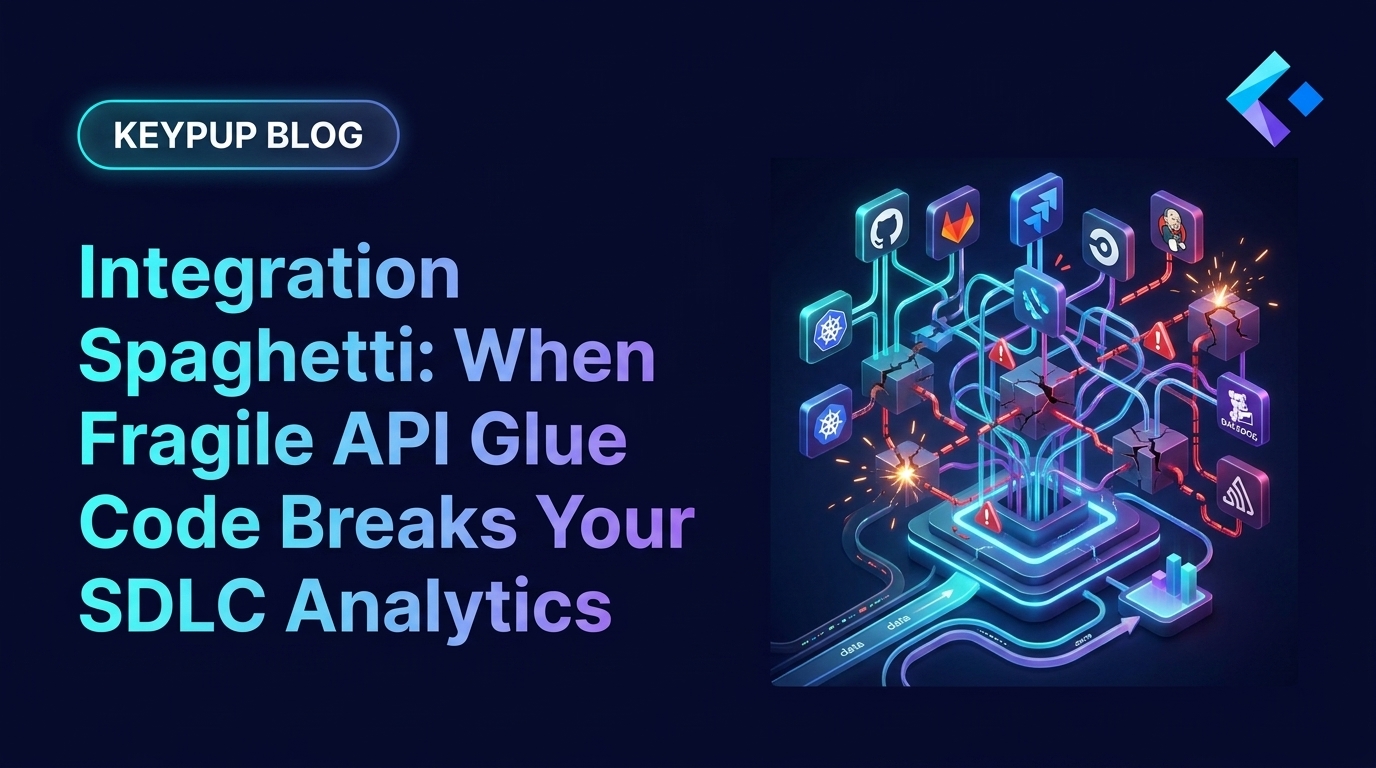
Integration Spaghetti: When Fragile API Glue Code Breaks Your SDLC Analytics

Integration Spaghetti: When Fragile API Glue Code Breaks Your SDLC Analytics

Building SDLC analytics requires integrating GitHub, Jira, Jenkins, Kubernetes, and monitoring tools. But custom API glue code is brittle, breaks constantly, and loses data. Discover how to get complete engineering insights without maintaining fragile integrations.

Thomas Williams